
The Theatrical Vision Problem: Hostile Optical Environments in Live Show Control
// Why standard tracking algorithms fail on concert stages and why wearable RF tags are operationally impractical
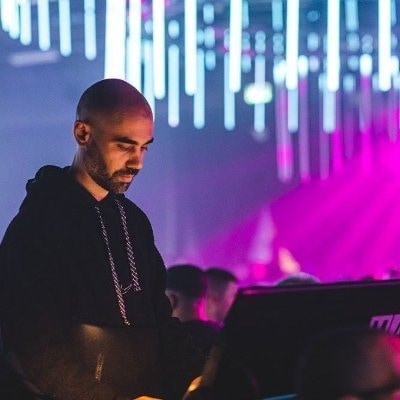
Live concert stages represent a uniquely hostile optical environment for computer vision systems. High-intensity moving spotlights, blinding strobe flashes, heavy atmospheric fog, colored laser beams, and dark shadows create rapid, unpredictable illumination swings that blind standard computer vision models.
Furthermore, concert performances are dynamic and crowded. When backup dancers cross paths directly in front of the lead vocalist, traditional centroid-based tracking systems frequently lose track of the target or jump to the wrong person, inadvertently directing moving spotlights away from the star performer.
Historically, touring productions attempted to solve this with wearable hardware: sewing Ultra-Wideband (UWB) or Infrared (IR) beacon tags into artist costumes. However, wearable tags suffer from operational friction: performers forget them during rapid 30-second costume changes, battery packs fail mid-show, and wireless microphone transmitters cause radio frequency (RF) interference. StageEye was developed as an exploratory R&D prototype in close collaboration with Naor Bonomo, a veteran lighting designer and stage director with over 20 years of international concert production experience. The prototype investigates markerless optical tracking: coupling natural human vision features with direct theatrical network protocol control, tested on virtual stage visualizers and bench test rigs.
- ▪Zero wearable hardware: Investigates replacing fragile radio beacons, battery packs, and costume modifications with markerless optical tracking.
- ▪Sub-frame lighting synchronization: Broadcasts real-time fixture updates at a deterministic 44Hz over standard theatrical Ethernet networks.
- ▪Immunity to optical stage chaos: Dual-layer visual architecture prevents spotlight stealing during dancer crosses, strobe bursts, and shadow transitions.
Dual-Layer Performer Tracking: Ultralytics YOLO and Facial Re-Identification
// Maintaining continuous identity lock through lighting flashes, smoke occlusions, and crossing dancers
To achieve reliable tracking without wearable tags, StageEye decouples coarse spatial localization from identity verification using a high-speed, two-tier computer vision pipeline.
Tier 1 runs an optimized Ultralytics YOLO object detection model accelerated via Apple Silicon Metal (MPS) and NVIDIA CUDA. Running at 60 FPS, Tier 1 outputs tight bounding boxes and center-of-mass coordinates for every individual on stage. However, because YOLO does not distinguish between performers and backup dancers, Tier 2 executes a deep facial and upper-body Re-Identification (Re-ID) embedding model.
When performers cross paths or the artist turns their back, a predictive Kalman filter projects the artist continuous trajectory while the Re-ID engine continuously compares 512-dimensional feature vectors. If a backup dancer temporarily occludes the artist, the spotlight holds its kinematic trajectory and re-locks onto the lead performer the instant their profile re-emerges, completely preventing spotlight stealing.
import numpy as np
from typing import List, Optional, Tuple
from dataclasses import dataclass

@dataclass
class TrackedPerformer:
    track_id: int
    centroid: Tuple[float, float]
    bbox: Tuple[float, float, float, float]
    reid_embedding: np.ndarray
    confidence: float
    is_lead_artist: bool

class DualLayerTracker:
    def __init__(self, lead_artist_embedding: np.ndarray, similarity_threshold: float = 0.78):
        self.lead_artist_embedding = lead_artist_embedding
        self.similarity_threshold = similarity_threshold
        self.active_tracks: List[TrackedPerformer] = []

    def cosine_similarity(self, a: np.ndarray, b: np.ndarray) -> float:
        norm_a = np.linalg.norm(a)
        norm_b = np.linalg.norm(b)
        if norm_a == 0 or norm_b == 0:
            return 0.0
        return float(np.dot(a, b) / (norm_a * norm_b))

    def update_frame(self, detections: List[Tuple[float, float, float, float]],
                     crops: List[np.ndarray]) -> Optional[TrackedPerformer]:
        """
        Correlates Tier 1 YOLO bounding boxes with Tier 2 Re-ID feature embeddings,
        ensuring the moving spotlight never jumps to an intersecting dancer.
        """
        best_candidate: Optional[TrackedPerformer] = None
        highest_similarity = -1.0

        for bbox, crop in zip(detections, crops):
            # Extract 512-dimensional facial/upper-body appearance embedding
            crop_embedding = self.extract_reid_features(crop)
            sim = self.cosine_similarity(self.lead_artist_embedding, crop_embedding)

            x1, y1, x2, y2 = bbox
            centroid = ((x1 + x2) / 2.0, (y1 + y2) / 2.0)

            if sim > self.similarity_threshold and sim > highest_similarity:
                highest_similarity = sim
                best_candidate = TrackedPerformer(
                    track_id=1,
                    centroid=centroid,
                    bbox=bbox,
                    reid_embedding=crop_embedding,
                    confidence=sim,
                    is_lead_artist=True
                )

        return best_candidate

    def extract_reid_features(self, crop: np.ndarray) -> np.ndarray:
        # In production, executes TensorRT / Metal accelerated forward pass
        # returning normalized 512-dimensional feature embedding
return np.random.randn(512).astype(np.float32)Architecture Topology and Show Control Pipeline
// Strict decoupling between image acquisition, vision inference, kinematic smoothing, and lighting network protocols
Live show control demands zero dropped frames. If a vision inference batch experiences a momentary 15ms latency spike, lighting fixtures must not stutter or pause their physical motion.
The StageEye architecture achieves rock-solid stability by decoupling image acquisition, neural vision inference, kinematic smoothing, and network protocol transmission onto independent execution threads communicating over lock-free circular queues.
The protocol transmission engine runs on a dedicated high-priority multimedia timer, broadcasting frame-synchronized DMX packets at 44Hz regardless of camera frame rate or background UI updates.
- 📁 stage-tracker/# Root StageEye tracking and show control repository
- 📁 capture/# High-speed camera ingestion and frame pre-processing
- 📄 video_source.py# Industrial USB3/GigE camera interface
- 📄 frame_buffer.py# Lock-free ring buffer for zero-copy frames
- 📁 vision/# Dual-layer YOLO and facial Re-ID neural networks
- 📄 yolo_detector.py# Ultralytics YOLO inference (Metal/CUDA)
- 📄 reid_embedder.py# Facial and torso feature extraction
- 📄 kalman_filter.py# Performer trajectory state estimation
- 📁 kinematics/# Self-learning motor calibration and motion smoothing
- 📄 pulse_calibration.py# Automated DMX test pulse fixture mapper
- 📄 motion_smoother.py# Dual-speed exponential damping filter
- 📄 geometric_transform.py# Camera pixel to 3D stage coordinate solver
- 📁 protocols/# Theatrical lighting network broadcasters
- 📄 sacn_sender.py# ANSI E1.31 streaming ACN UDP multicast engine
- 📄 artnet_sender.py# Art-Net DMX-over-Ethernet unicast broadcaster
- 📄 gma_bridge.py# GrandMA3 / GrandMA2 Telnet and OSC console link
- 📁 streaming/# Real-time media and projection mapping feeds
- 📄 ndi_output.py# 1080p transparent alpha NDI video streamer
- 📁 tests/# Simulation tests and protocol packet verifiers
- 📄 test_sacn_packets.py# E1.31 byte layout and universe header tests
- 📄 test_kinematics.py# Motor angle convergence simulations
Experimental Kinematics: 2D Pixel-to-DMX Fixture Mapping and the Mounting Dilemma
// Replacing fragile 3D laser surveying with 2D camera coordinate mapping, discrete motor stepping, and beam degradation handling
In traditional stage tracking installations, touring technicians spend hours prior to every show using handheld laser rangefinders to survey the exact physical location (X, Y, Z coordinates, pitch, roll, and yaw) of every moving fixture relative to the stage floor. If a lighting truss shifts or vibrates during show setup, the entire 3D spatial alignment is invalidated.
In practice, moving head fixtures (such as a Robe MegaPointe) present an immediate physical mounting challenge: stagehands clamp fixtures onto truss pipes at varying, arbitrary rotations. Even if Pan 0 and Tilt 0 point straight down, raising Tilt by 50 degrees on one fixture might project the beam straight downstage, while on a fixture clamped at a 90-degree offset it swings awkwardly into the wings. Standardizing fixture movements through full 3D inverse kinematics requires precise camera extrinsics and fixture spatial measurements that are brittle in fast-paced production setups.
StageEye approached this problem through pure 2D pixel-space calibration rather than 3D spatial reconstruction. First, the operator defines the active stage boundary by dragging a 2D bounding rectangle over the camera feed. To calibrate a fixture, the system commands an initial exploratory tilt drop (e.g. 50 degrees) to project a test light pool onto the stage floor within the camera view. Once the spot centroid is detected, the engine executes discrete 5-degree motor steps across pan and tilt, logging where each step lands on the camera pixel grid to build a direct 2D-pixel-to-DMX lookup table across the stage.
The calibration logic also accounts for spot degradation geometry: a spotlight only forms a circular pool when pointing straight down at nadir; as the beam projects toward steep downstage angles, the spot elongates into an acute, lower-intensity ellipse. During bench testing, this discrete step-by-step exploration proved computationally straightforward but mechanically time-consuming, as physical motors require 150ms to 300ms to settle after each angular step before the camera can capture an unblurred centroid.
As a theoretical direction for future research, an open hypothesis emerged: rather than stop-and-go discrete 5-degree steps, the system could drive the fixture in a smooth, continuous rotational sweep while recording camera frames at 60 FPS with synchronized DMX timestamps. Under this untested hypothesis, the beam sweep would intersect the operator-drawn stage rectangle dynamically, potentially deriving boundary limits and interpolation curves in fluid motion without mechanical settling delays.
Manual Laser Venue Surveying
Technicians must manually shoot laser lines from high ladders or scissor lifts to calibrate 3D coordinates, risking human error and show delays.
Wearable UWB RF Tag Anchors
Requires deploying 6-12 perimeter anchor antennas around the stage perimeter, susceptible to multi-path reflections and wireless mic interference.
StageEye 2D Step Calibration (R&D)
Pure 2D pixel mapping avoids brittle 3D surveying; experimental bench tests highlighted motor settling latency during discrete stepping as a key optimization area.
Theatrical Network Protocols: sACN (ANSI E1.31) and Art-Net at 44Hz
// Sub-frame UDP broadcasting, multicast universe routing, and zero-dropped-packet fixture control
Professional stage lighting fixtures: manufactured by industry leaders such as Robe, Claypaky, and Martin: receive digital control signals over standard Ethernet cabling using dedicated theatrical protocols.
StageEye incorporates a native, binary network protocol engine supporting both Streaming ACN (ANSI E1.31 sACN) and Art-Net. Control commands are encapsulated into standardized UDP packets, routing 16-bit high-resolution Pan and Tilt parameters directly to target fixture universes.
To ensure seamless compatibility with entertainment consoles and eliminate visible stepping, the transmission engine operates at a deterministic 44Hz refresh rate (the international standard DMX512 frame rate). A dual-speed kinematic smoothing filter cushions rapid dancer accelerations, producing elegant, theatrical spotlight movements without mechanical jerk or motor overshoot.
import socket
import struct
from typing import Tuple

class SacnSender:
    """
    Constructs and broadcasts compliant ANSI E1.31 (sACN) UDP multicast packets
    for frame-synchronized 16-bit moving light fixture control.
    """
    ACN_PORT = 5568
    ROOT_VECTOR = 0x00000004
    FRAMING_VECTOR = 0x00000002
    DMP_VECTOR = 0x02

    def __init__(self, universe: int = 1):
        self.universe = universe
        self.sequence_number = 0
        self.socket = socket.socket(socket.AF_INET, socket.SOCK_DGRAM, socket.IPPROTO_UDP)
        # Calculate standard sACN multicast IP for target universe (239.255.U_HI.U_LO)
        self.multicast_ip = f"239.255.{universe >> 8}.{universe & 0xFF}"

    def send_fixture_coordinates(self, dmx_channel_start: int, pan_norm: float, tilt_norm: float):
        """
        Converts normalized (0.0 to 1.0) stage coordinates into 16-bit coarse/fine
        DMX parameters and broadcasts a 512-channel sACN packet.
        """
        # Convert to 16-bit integers (0 to 65535) for smooth sub-millimeter positioning
        pan_16bit = int(np.clip(pan_norm, 0.0, 1.0) * 65535)
        tilt_16bit = int(np.clip(tilt_norm, 0.0, 1.0) * 65535)

        dmx_slots = bytearray(513) # Start code 0x00 followed by 512 channel values

        # Pan Coarse & Fine
        dmx_slots[dmx_channel_start] = (pan_16bit >> 8) & 0xFF
        dmx_slots[dmx_channel_start + 1] = pan_16bit & 0xFF

        # Tilt Coarse & Fine
        dmx_slots[dmx_channel_start + 2] = (tilt_16bit >> 8) & 0xFF
        dmx_slots[dmx_channel_start + 3] = tilt_16bit & 0xFF

        packet = self._build_e131_packet(dmx_slots)
        self.socket.sendto(packet, (self.multicast_ip, self.ACN_PORT))
        self.sequence_number = (self.sequence_number + 1) % 256

    def _build_e131_packet(self, dmx_data: bytearray) -> bytes:
        # Preamble size (0x0010) and Post-amble size (0x0000) followed by ACN packet ID
        header = bytearray(126)
        struct.pack_into(">HH12s", header, 0, 0x0010, 0x0000, b"ASC-E1.17\x00\x00\x00")

        # Root layer flags and vector
        struct.pack_into(">HI", header, 16, 0x7000 | 638, self.ROOT_VECTOR)

        # Framing layer: sequence number, universe ID
        struct.pack_into(">HIBH", header, 110, 0x7000 | 600, self.FRAMING_VECTOR, self.sequence_number, self.universe)

        # DMP layer: flags, vector, start code, address increment
        struct.pack_into(">HBBBHH", header, 118, 0x7000 | 523, self.DMP_VECTOR, 0xa1, 0x00, 0x0001, 513)

return bytes(header) + bytes(dmx_data)GrandMA Console Integration: Automated Cue and Dimmer Injection
// Injecting real-time tracking offsets into GrandMA3 and GrandMA2 show files via Telnet and OSC
In major theatrical and concert productions, the Lighting Designer (LD) and console programmer maintain absolute authority over the visual aesthetic of the performance: governing color palettes, gobo projections, prism rotations, and master cue sequences via an industry-standard GrandMA console.
StageEye does not attempt to replace the lighting console; rather, it functions as an intelligent tracking co-pilot. By communicating bidirectionally over Open Sound Control (OSC) and raw Telnet command-line interfaces, StageEye dynamically injects pan/tilt positional offsets while respecting console priorities.
Furthermore, StageEye executes automated stage boundary actions. When the performer walks down a thrust stage into the crowd, the system signals the console to smoothly fade up audience blinders. When the performer exits to the wings, the system gracefully fades the spotlight dimmer to zero, preventing the light beam from illuminating backstage crew members.
- ▪Non-destructive console co-pilot: Injects positional data while preserving the lighting designer complete control over color, beam size, and cues.
- ▪Automated boundary zones: Automatically fades spotlight intensity when the performer steps outside active performance zones.
- ▪Bidirectional cue synchronization: Listens to incoming console cue changes to automatically arm or disarm tracking during specific musical numbers.
Interactive Visual Effects: 1080p Transparent NDI Streaming to TouchDesigner
// Streaming real-time performer cutouts with alpha channels for dynamic projection mapping
Modern live concert design seamlessly blends automated lighting with interactive video projection mapping. Visual designers increasingly require real-time performer masks to project aura effects, digital particle trails, or live camera outlines directly onto the moving artist on stage.
StageEye leverages its neural segmentation engine to isolate the performer from the stage background in real time. The isolated performer video feed is converted into an ultra-low-latency 1080p 60 FPS Network Device Interface (NDI) video stream containing a clean, 8-bit transparent alpha channel.
Media servers such as TouchDesigner, Resolume Arena, or disguise ingest the NDI stream over the venue local Gigabit network with under 30 milliseconds of latency. Video artists can composite interactive particle graphics directly onto the live performer body with zero tracking markers or green-screen backdrops.
- ▪High-definition transparent alpha stream: Delivers 1080p 60 FPS performer cutouts over standard Ethernet networks.
- ▪Sub-30ms glass-to-glass latency: Video frames arrive fast enough for real-time laser and projection mapping without visible lag.
- ▪Universal media server compatibility: Connects natively with TouchDesigner, Resolume, Notch, and disguise without specialized capture hardware.
Engineering Takeaways for Live Show Control and Vision Systems
// Essential architectural lessons for deploying computer vision into high-stakes live entertainment
Deploying computer vision into mission-critical live entertainment environments requires engineering for extreme optical and physical variability. Keep these four design lessons in mind:
- ▪Never rely solely on spatial bounding boxes: In dynamic stage lighting, combine coarse object detection with deep Re-ID embeddings and predictive Kalman filtering to prevent identity swaps.
- ▪Map fixtures in 2D image space to simplify kinematics: Mapping camera pixels directly to DMX values avoids complex 3D extrinsic surveying, while continuous sweep architectures remain a promising hypothesis for accelerating calibration.
- ▪Broadcast over native entertainment protocols: Integrate directly with standard theatrical protocols (sACN ANSI E1.31, Art-Net, GrandMA OSC) rather than introducing proprietary hardware controllers.
- ▪Decouple neural vision inference from lighting network output: Run camera acquisition, inference, and DMX transmission on isolated threads to guarantee rock-solid 44Hz lighting output without frame jitter.
Deploying real-time computer vision or theatrical show control?
We engineer hardware-accelerated tracking pipelines, custom fixture kinematics, and frame-synchronized network broadcasting.